People and the environment
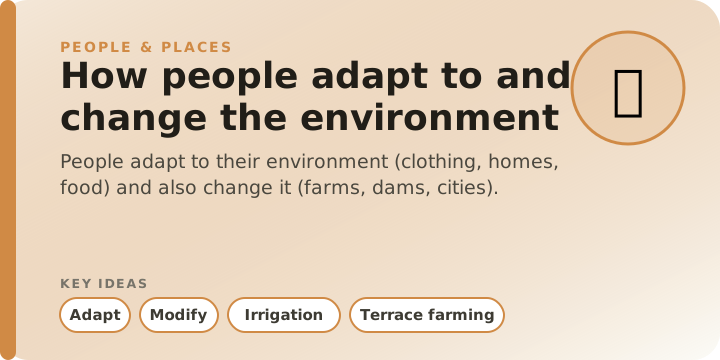
The environment is the natural world around us: land, water, air, plants and animals. People and the environment affect each other in two ways:
- People adapt to their environment: they change how they live to fit their surroundings.
- People modify the environment: they change it to meet their needs.
How people adapt
People have found clever ways to live in every kind of environment on Earth.
| Environment | Adaptations |
|---|---|
| Cold Arctic | warm clothing made from animal skins and furs, igloos as temporary winter shelters, dog sleds and snowmobiles, hunting seals and caribou |
| Hot, dry desert | loose, light-coloured clothing; thick-walled homes that stay cool; living near oases; travelling at night |
| Rainy coast | houses on stilts or with steep roofs; raincoats and boots; fishing and boats |
| Mountains | terraced farming on slopes; raising goats and llamas; sturdy stone homes |
| Prairie | farming grains suited to dry summers; windbreaks of trees to protect fields |
Indigenous knowledge
For thousands of years, Indigenous peoples have adapted in ways that respect the land.
- Inuit built igloos for winter travel, made warm caribou-skin clothing and used kayaks to hunt.
- Plains nations followed the bison, using nearly every part of the animal for food, clothing, tools and tipis that could be moved.
- West Coast nations built large cedar plank houses and canoes and harvested salmon each year.
- Haudenosaunee farmers grew the "Three Sisters" (corn, beans and squash) together, which helped the soil and the plants.
How people modify the environment
People also change the environment to make life easier.
| Change | Benefit | Possible problem |
|---|---|---|
| Building cities and roads | homes, jobs, transportation | loss of habitat, more pollution |
| Irrigation | crops can grow on dry land | rivers and underground water can run low |
| Dams | hydroelectric power, water supply, flood control | flood land and change rivers and fish habitats |
| Cutting forests | wood, paper, farmland | deforestation, erosion, loss of habitat |
| Mining | metals and fuels | scarred land, water pollution |
| Farming | food | soil loss, chemicals in water |
Some changes are helpful, but they can also cause harm. Most choices involve trade-offs.
Pollution
Pollution happens when harmful substances get into the air, water or land.
- Air: smoke from factories, cars and wildfires
- Water: chemicals, sewage and plastic in rivers, lakes and oceans
- Land: garbage in landfills and litter
Pollution can harm people, plants and animals.
Protecting the environment
Conservation means protecting and carefully using natural resources so they last.
What governments and communities do
- create national and provincial parks and protected areas
- set rules to limit pollution
- plant trees after logging
- build recycling and composting programs
- use renewable energy like wind and solar power
What you can do
- Reduce: use less; turn off lights and taps
- Reuse: use containers and bags again
- Recycle: sort paper, plastic, glass and metal
- walk, bike or take the bus when you can
- plant trees, flowers or a garden
- pick up litter and protect local wildlife
Example: the Prairies
When settlers arrived on the Prairies, they ploughed up the grasslands to plant wheat. In the 1930s, drought and strong winds blew away the dry topsoil, creating the Dust Bowl. Farmers then adapted by planting rows of trees as windbreaks, rotating crops and using methods that protect the soil.
Try it yourself
- Choose an environment. Describe how people adapt to it: clothing, homes, food and transportation.
- Find one way people have modified the environment in your community. Was it helpful, harmful or both?
- Make a poster showing three ways your class can practise conservation.
- Compare how two different Indigenous nations adapted to their environments.
Quick recap
- People adapt to their environment and also modify it.
- Adaptations include clothing, homes, food and ways of travelling.
- Modifications like dams, irrigation and cities bring benefits and problems.
- Pollution harms the air, water and land.
- Conservation helps protect resources for the future.