What is a colony?
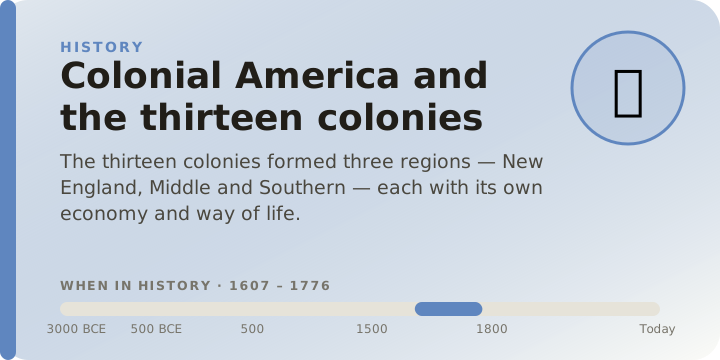
A colony is a settlement or territory ruled by another country. In the 1600s and 1700s, England (later Great Britain) set up thirteen colonies along the Atlantic coast of North America. These colonies later became the first thirteen states of the United States.
The land was already home to many Native nations, such as the Powhatan, Wampanoag, Lenape and Cherokee. Colonization brought trade and sometimes cooperation, but also wars, disease and the loss of Native lands.
Why people came
- Money: companies and settlers hoped to grow rich from land, farming, furs, fishing and trade.
- Religious freedom: groups like the Pilgrims, Puritans and Quakers wanted to worship in their own way.
- Land and a new start: many poor Europeans hoped to own land.
- Forced migration: hundreds of thousands of Africans were captured, enslaved and brought against their will.
Early settlements
- Jamestown, Virginia (1607): the first permanent English settlement. Early years were very hard. Tobacco, introduced as a cash crop by John Rolfe, made the colony profitable. The Powhatan people helped and also fought the colonists.
- Plymouth, Massachusetts (1620): founded by the Pilgrims, who sailed on the Mayflower. They signed the Mayflower Compact, an early agreement to govern themselves. The Wampanoag, including Tisquantum (Squanto), helped them survive.
Three regions of colonies
| Region | Colonies | Geography and climate | Economy | Life and society |
|---|---|---|---|---|
| New England colonies | Massachusetts, New Hampshire, Connecticut, Rhode Island | rocky soil, forests, cold winters, harbours | fishing, whaling, shipbuilding, trade, small farms | Puritan religion, town meetings, schools |
| Middle colonies | New York, New Jersey, Pennsylvania, Delaware | fertile soil, milder climate, rivers | wheat and other grains ("breadbasket colonies"), trade | very diverse peoples and religions; Quakers in Pennsylvania |
| Southern colonies | Maryland, Virginia, North Carolina, South Carolina, Georgia | warm climate, long growing season, rich soil | plantations growing tobacco, rice and indigo | large farms, enslaved labour, fewer towns |
Slavery in the colonies
Slavery existed in all thirteen colonies but was most widespread in the South, where plantations depended on the forced labour of enslaved Africans. Enslaved people were treated as property, separated from families and denied freedom. Despite this, they kept African traditions alive, built communities and resisted in many ways.
Daily life
- Most colonists lived on farms and made much of what they needed: candles, soap, cloth and food.
- Children helped with chores. Some boys became apprentices to learn trades like blacksmithing or printing.
- In New England, towns built schools so children could read the Bible.
Colonial government
Each colony had a governor, often chosen by the king. But colonists also practised self-government:
- Virginia’s House of Burgesses (1619) was the first elected assembly in the colonies.
- Town meetings in New England let free men vote on local issues.
Only some people could vote, usually free white men who owned property.
Growing tensions
By the mid-1700s, the colonies had grown large and confident. After Britain won the French and Indian War (1754–1763), it taxed the colonies to pay its war debts. Many colonists protested "taxation without representation." These tensions led to the American Revolution.
Try it yourself
- Colour a map of the thirteen colonies by region.
- Make a chart comparing the economies of the three regions.
- Write a letter from a colonist describing daily life in one region.
- Explain how geography shaped the economy of each region.
Quick recap
- The thirteen colonies were British colonies on the Atlantic coast.
- People came for money, land, and religious freedom; enslaved Africans were brought by force.
- New England, the Middle and the Southern colonies had different geography and economies.
- Slavery was central to the Southern plantation economy.
- Colonists practised some self-government, which helped lead to the Revolution.