What is a civilization?
A civilization is a complex society. Historians usually look for these features:
| Feature | Example |
|---|---|
| Cities | Ur, Memphis, Mohenjo-daro, Athens |
| Organized government | kings, pharaohs, councils |
| Religion | temples, priests, gods and goddesses |
| Social classes | rulers, priests, merchants, farmers, enslaved people |
| Job specialization | potters, scribes, builders, soldiers |
| Writing | cuneiform, hieroglyphics, Chinese characters |
| Arts and architecture | pyramids, ziggurats, statues |
| Public works | irrigation canals, walls, roads |
How civilizations began
About 10,000 years ago, people in several regions began farming instead of only hunting and gathering. This is often called the Agricultural Revolution.
Farming produced a surplus: extra food. With extra food, not everyone had to farm. Some people became craftspeople, traders, priests or leaders. Villages grew into cities, and cities needed government, laws and record-keeping, which led to writing.
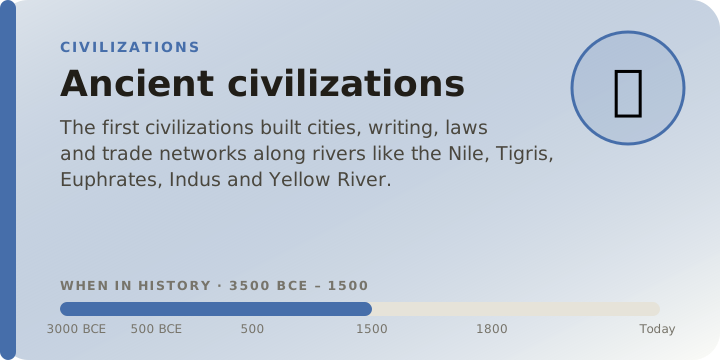
Many of the first civilizations grew in river valleys, where rivers provided water, fertile soil from floods, and transportation.
The first civilizations
| Civilization | Where | When (approx.) | Achievements |
|---|---|---|---|
| Mesopotamia (Sumer, Babylon) | between the Tigris and Euphrates Rivers (modern Iraq) | from about 3500 BCE | cuneiform writing, the wheel, ziggurats, Hammurabi’s Code (about 1754 BCE), early math and astronomy |
| Ancient Egypt | Nile River valley | about 3100–30 BCE | hieroglyphics, pyramids (Great Pyramid about 2560 BCE), papyrus, a 365-day calendar, medicine |
| Indus Valley (Harappan) | Indus River (modern Pakistan and northwest India) | about 2600–1900 BCE | planned cities with grid streets, drainage and sewer systems, standardized weights |
| Ancient China | Huang He (Yellow River) and Yangtze | Shang dynasty about 1600–1046 BCE; unified under the Qin in 221 BCE | oracle-bone writing, bronze, silk, the Great Wall, paper (later), Confucian ideas |
Mesopotamia: the "land between the rivers"
Sumerians lived in city-states such as Ur and Uruk. A city-state is an independent city that rules itself and nearby land. Each had a temple called a ziggurat. Sumerians developed cuneiform around 3200 BCE to keep records of grain and trade. Later, King Hammurabi of Babylon created one of the earliest written law codes.
Egypt: gift of the Nile
The Nile flooded every year, leaving rich black soil. Pharaohs were seen as god-kings. Egyptians built pyramids as tombs, preserved bodies as mummies, and wrote in hieroglyphics. The Rosetta Stone, found in 1799, helped scholars finally read hieroglyphics.
Classical civilizations
Later civilizations built on earlier ones.
| Civilization | Key contributions |
|---|---|
| Ancient Greece | democracy in Athens (about 508 BCE), philosophy (Socrates, Plato, Aristotle), theatre, the Olympic Games, geometry |
| Ancient Rome | republic and later empire; law; roads, aqueducts and arches; Latin, the root of many modern languages |
| Persia | a large empire with roads and a postal system; tolerance of different cultures |
| Ancient India | the Maurya and Gupta empires; the decimal number system and zero; Hinduism and Buddhism |
Civilizations of the Americas
Civilizations also developed independently in the Americas:
- Olmec (Mexico, about 1200–400 BCE): giant stone heads
- Maya (Mexico and Central America): advanced writing, calendars, astronomy and the concept of zero
- Aztec (Mexico, 1300s–1521): Tenochtitlan, built on a lake, one of the world’s largest cities at the time
- Inca (Andes, 1400s–1533): a huge empire with roads, terraced farms and record-keeping with knotted cords called quipu
Why study ancient civilizations?
Many things we use today began long ago: writing, laws, calendars, math, cities, democracy and engineering. Studying ancient civilizations helps us understand how societies grow, solve problems and sometimes collapse, whether because of war, drought, disease or overuse of resources.
Try it yourself
- Choose a civilization and make a poster showing each feature of civilization.
- Explain why so many civilizations began in river valleys.
- Compare Mesopotamia and Egypt: geography, government, writing and buildings.
- List five inventions from ancient civilizations that we still use.
Quick recap
- A civilization has cities, government, religion, social classes, specialized jobs and writing.
- Farming surpluses allowed cities and specialization to develop.
- Early civilizations grew in river valleys: Mesopotamia, Egypt, the Indus Valley and China.
- Greece, Rome and other classical civilizations built on earlier achievements.
- The Americas developed their own civilizations, such as the Maya, Aztec and Inca.