A note before reading: This lesson discusses difficult history, including harm to children. It’s okay to take breaks and to talk with a trusted adult. Support for anyone affected by residential schools is available 24 hours a day through the Indian Residential Schools Crisis Line at 1-866-925-4419.
What were residential schools?
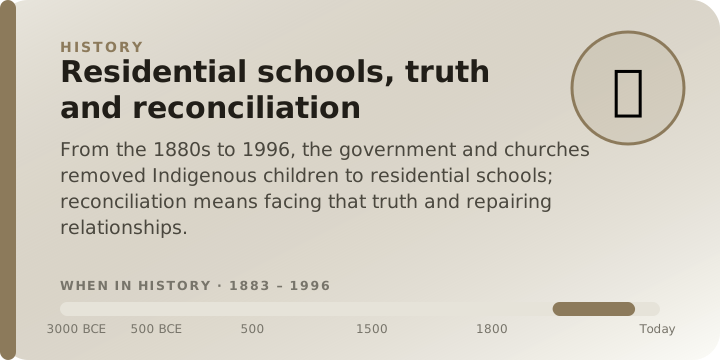
Residential schools were boarding schools for Indigenous children, funded by the Government of Canada and run mostly by churches (Roman Catholic, Anglican, Methodist, Presbyterian and later United). They operated from the 1800s until 1996, when the last federally run school closed in Saskatchewan.
More than 150,000 First Nations, Inuit and Métis children attended. Many were taken from their families, sometimes by force, and sent far from home. After 1920, attendance was mandatory for many First Nations children.
Why were they created?
The government’s goal was assimilation: to make Indigenous children give up their languages, cultures, spiritual beliefs and identities and adopt Euro-Canadian ways. Government officials openly described the aim as removing Indigenous culture from children. The schools were part of broader policies, including the Indian Act, meant to take control of Indigenous lands and lives.
Life at the schools
Survivors have described:
- being separated from parents, brothers and sisters, sometimes for years
- having their hair cut and their clothing taken away
- being punished for speaking their own languages
- poor food, crowded buildings and disease
- half-days of classes and half-days of hard labour in many schools
- physical, emotional and sexual abuse
- loneliness and fear
Thousands of children died at the schools, from diseases such as tuberculosis, poor conditions, accidents and abuse. Many families were never told what happened to their children, and many children were buried far from home, sometimes in unmarked graves.
Some Survivors also remember kind staff, friendships and learning skills. Many showed great courage and resistance, secretly keeping their languages and traditions alive.
Lasting impacts
The harm did not end when the schools closed. Impacts include:
- loss of Indigenous languages and cultural knowledge
- broken family bonds and parenting traditions
- intergenerational trauma: harm passed from Survivors to their children and grandchildren
- higher rates of poverty, health problems and family separation in some communities
The Sixties Scoop, beginning in the 1950s and 60s, when many Indigenous children were taken from their families and placed in non-Indigenous homes, continued this harm.
Truth: telling the story
- In 2008, Prime Minister Stephen Harper apologized in Parliament on behalf of the Government of Canada.
- The Truth and Reconciliation Commission (TRC) of Canada, led by Justice Murray Sinclair, worked from 2008 to 2015. It gathered statements from more than 6,500 Survivors and witnesses.
- In 2015, it released its final report and 94 Calls to Action.
- In 2021, the Tk’emlúps te Secwépemc First Nation announced the detection of possible unmarked graves near the former Kamloops Indian Residential School. Searches at other former school sites followed.
- In 2022, Pope Francis apologized in Canada for the role of members of the Catholic Church.
Reconciliation
Reconciliation means building respectful relationships between Indigenous and non-Indigenous peoples. It requires learning the truth, acknowledging harm, and taking action. The TRC’s Calls to Action cover areas such as:
- child welfare, education, language and culture, health and justice
- teaching residential school history in schools
- commemoration and remembering the children who never came home
Ways to remember
- September 30: the National Day for Truth and Reconciliation (a federal statutory holiday since 2021) and Orange Shirt Day, inspired by Survivor Phyllis Webstad, whose new orange shirt was taken on her first day at residential school in 1973. Its message is "Every Child Matters."
- Learning whose land you live on and its history
- Supporting Indigenous languages, artists, businesses and communities
- Listening to Survivors’ stories with respect
Try it yourself
- Write a reflection: What does "Every Child Matters" mean to you?
- Read one Call to Action for education. What could your school do to respond?
- Learn about a Survivor’s story from a trusted source, such as the National Centre for Truth and Reconciliation.
- Plan a respectful Orange Shirt Day activity for your class.
Quick recap
- Residential schools operated in Canada until 1996, with the goal of assimilation.
- More than 150,000 Indigenous children attended, and many suffered abuse and loss.
- The effects continue today through intergenerational trauma.
- The Truth and Reconciliation Commission issued 94 Calls to Action in 2015.
- Reconciliation means learning the truth and taking action together.