What is a revolution?
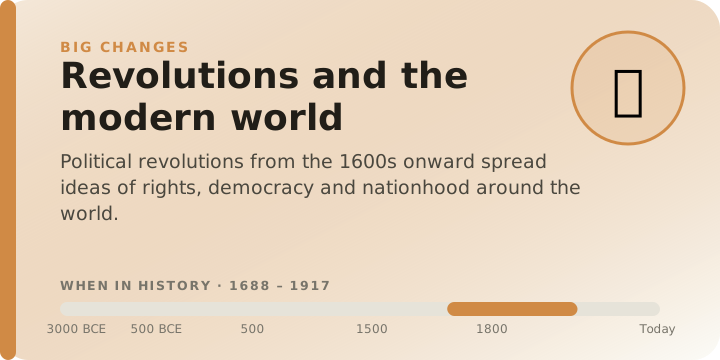
A revolution is a fundamental change in who holds power or how society is organized. Some revolutions are political and sudden, overthrowing governments. Others, like the Industrial Revolution, transform economies and daily life over decades.
Revolutions have shaped the modern world: democracy, rights, nations, industry and global politics all trace back to revolutionary change.
Ideas behind the revolutions: the Enlightenment
The Enlightenment of the 1700s emphasized reason, science and individual rights.
| Thinker | Key idea |
|---|---|
| John Locke | natural rights to life, liberty and property; government by consent |
| Montesquieu | separation of powers |
| Jean-Jacques Rousseau | the social contract and the general will; popular sovereignty |
| Voltaire | freedom of speech and religion |
| Mary Wollstonecraft | women’s rights and education |
The Atlantic revolutions
| Revolution | Dates | Causes | Results |
|---|---|---|---|
| American | 1775–1783 | taxation without representation; Enlightenment ideas | independence; Constitution and Bill of Rights |
| French | 1789–1799 | debt, inequality between estates, food shortages, Enlightenment ideas | end of absolute monarchy; Declaration of the Rights of Man; Reign of Terror; rise of Napoleon |
| Haitian | 1791–1804 | brutal slavery in Saint-Domingue; revolutionary ideals | the only successful large-scale slave revolt; Haiti becomes the first independent Black republic; led by Toussaint Louverture and Jean-Jacques Dessalines |
| Latin American | 1810–1825 | resentment of Spanish rule; Napoleon’s invasion of Spain | independence for most of Spanish and Portuguese America; leaders such as Simón Bolívar and José de San Martín |
The French Revolution
The French Revolution began in 1789 with the storming of the Bastille. Revolutionaries declared "Liberty, Equality, Fraternity." The monarchy was abolished and King Louis XVI was executed in 1793. During the Reign of Terror (1793–94), thousands were executed. Napoleon Bonaparte seized power in 1799 and later spread revolutionary laws, the Napoleonic Code, across Europe through conquest.
The Industrial Revolution
Beginning in Britain around 1760, the Industrial Revolution transformed how goods were made.
- Inventions: the steam engine, spinning jenny, power loom, railways
- Changes: factories, rapid urbanization, new middle and working classes
- Problems: child labour, dangerous working conditions, crowded slums and pollution
- Responses: labour unions, reform laws, and new ideologies such as socialism and Marxism
It spread to Europe, North America and Japan, and later worldwide, creating today’s industrial economies.
Nationalism and the revolutions of 1848
Nationalism, the belief that people sharing a language and culture should govern themselves, spread through the 1800s. In 1848, revolutions broke out across Europe. Most failed in the short term, but nationalism led to the unification of Italy (1861) and Germany (1871).
20th-century revolutions
| Revolution | Year | Outcome |
|---|---|---|
| Mexican | 1910–1920 | land reform; a new constitution (1917) |
| Russian | 1917 | the tsar overthrown; Bolsheviks under Lenin create the first communist state, the Soviet Union |
| Chinese | 1949 | communists under Mao Zedong win the civil war; People’s Republic of China |
| Cuban | 1959 | Fidel Castro takes power; communist state allied with the USSR |
| Iranian | 1979 | the Shah overthrown; Islamic Republic established |
| Revolutions of 1989 | 1989 | communist regimes fall across Eastern Europe, mostly peacefully |
| Arab Spring | 2010–2012 | protests across North Africa and the Middle East; mixed results, from democratic change in Tunisia to civil wars in Syria and Libya |
Decolonization
After 1945, decolonization swept Asia and Africa. India and Pakistan gained independence in 1947; Ghana in 1957 became the first sub-Saharan African colony to win independence; dozens of African nations followed in the 1960s. Some independence movements were peaceful, such as Gandhi’s nonviolent campaign in India; others involved long wars, such as in Algeria and Vietnam.
Patterns in revolutions
Historian Crane Brinton compared revolutions to a fever with stages:
- Old regime: growing problems, discontent and loss of faith in rulers
- First stage: moderates take power
- Crisis: radicals take over; violence and terror
- Recovery: a strong leader restores order (such as Napoleon)
Critics say not all revolutions follow this pattern, but it offers a useful lens.
Try it yourself
- Compare the causes and outcomes of two revolutions in a chart.
- Explain the significance of the Haitian Revolution and why it was often left out of history books.
- Apply Brinton’s stages to the French or Russian Revolution.
- Debate: "The Industrial Revolution did more to change the world than any political revolution."
Quick recap
- Revolutions are fundamental changes in power or society.
- Enlightenment ideas inspired the American, French, Haitian and Latin American revolutions.
- The Industrial Revolution transformed economies and daily life.
- Nationalism, communism and decolonization drove 19th- and 20th-century revolutions.
- Revolutions can bring rights and freedoms, but also violence and new forms of control.