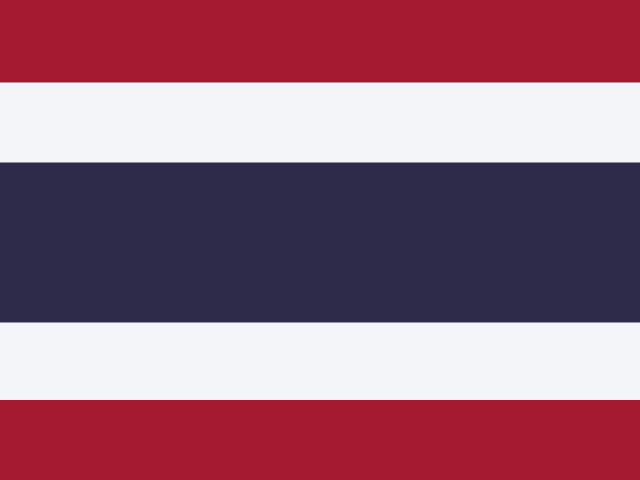
Thailand is a country in the heart of Southeast Asia, known as the “Land of Smiles” for the warmth of its people. It is famous for its golden Buddhist temples, tropical beaches, lively markets and delicious food. Thailand is also the only country in Southeast Asia that was never colonized by a European power.
Geography
Location and Size
Thailand covers about 513,000 square kilometres in the middle of mainland Southeast Asia. Its shape is often compared to an elephant’s head, with the long Malay Peninsula forming the trunk.
Borders
Thailand shares borders with Myanmar to the west and north, Laos to the northeast, Cambodia to the east and Malaysia to the south. Its coastline faces the Gulf of Thailand to the east and the Andaman Sea to the west.
Landforms and Climate
Thailand has mountains in the north, a dry plateau in the northeast, and a fertile central plain watered by the Chao Phraya River, where most of the country’s rice is grown. The Mekong River forms part of its border with Laos. The climate is tropical, with three main seasons: hot, rainy (monsoon) and cool.
Provinces
Thailand is divided into 76 provinces plus the special capital area of Bangkok.
History
Early Thai kingdoms grew up in the region more than 700 years ago. The Sukhothai Kingdom, founded in the 1200s, is often called the first Thai kingdom and is where the Thai alphabet was developed. It was followed by the powerful Ayutthaya Kingdom, which lasted for over 400 years and became a busy trading centre. In 1782, the Chakri dynasty founded Bangkok as the new capital, and its kings still reign today.
While neighbouring lands were taken over by Britain and France, the kingdom, then called Siam, stayed independent through careful diplomacy. In 1932, a revolution ended absolute monarchy and created a constitutional monarchy, and in 1939 the country’s name was changed from Siam to Thailand.
Government
Thailand is a constitutional monarchy. The King is the head of state and is deeply respected, while the Prime Minister leads the government. Laws are made by the National Assembly, which has two houses: the House of Representatives and the Senate.
Economy
Thailand has one of the largest economies in Southeast Asia. Tourism is very important, with millions of visitors each year. The country manufactures many cars and electronics, earning Bangkok the nickname “Detroit of Asia.” Farming is also important: Thailand is one of the world’s biggest exporters of rice and the largest producer of natural rubber.
Culture
Most Thai people follow Theravada Buddhism, and colourful temples called wats are found in every town. People greet each other with the wai, a slight bow with palms pressed together. Famous festivals include Songkran, the Thai New Year in April, when people splash water to wash away bad luck, and Loy Krathong, when floating baskets with candles are set on rivers. Thai food, such as pad thai, tom yum soup, green curry and mango sticky rice, is known for balancing sweet, sour, salty and spicy flavours. The traditional martial art Muay Thai is a popular national sport.
People
Thailand has a population of about 70 million people. Most are ethnic Thai, along with large Chinese-Thai, Malay and hill-tribe communities. The official language is Thai, which has its own alphabet and is a tonal language, meaning the pitch of your voice can change a word’s meaning. Bangkok, the capital, is home to more than 10 million people.
Fun Facts
- Bangkok’s full ceremonial name is one of the longest place names in the world, with more than 160 letters.
- The Thai elephant is the national animal of Thailand.
- The Thai alphabet has 44 consonant letters.
- Thailand is the only country in Southeast Asia never colonized by a European nation.
Exploring Thailand reveals a country of golden temples, busy floating markets, peaceful rice fields and beautiful islands. Its proud history, friendly culture and world-famous food make Thailand a fascinating place to learn about.